
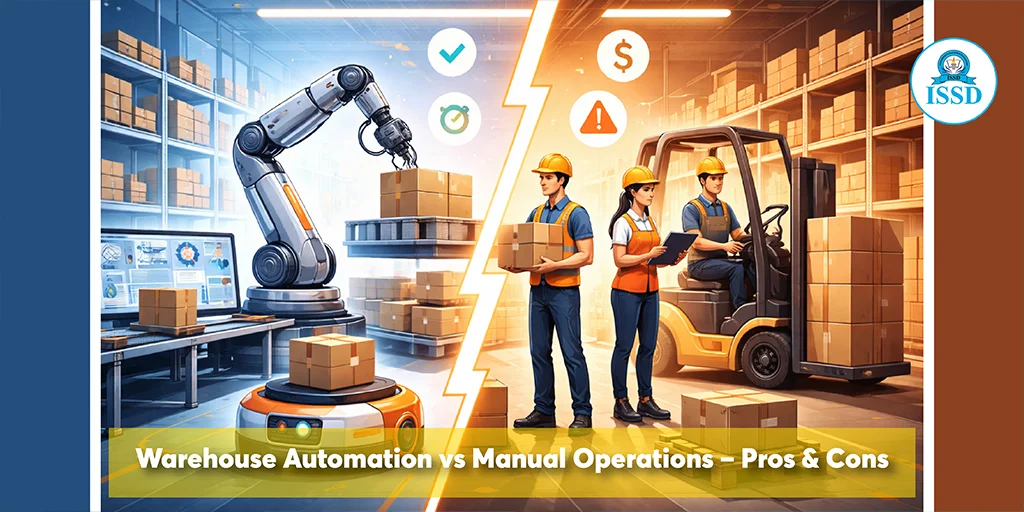
Warehouse Automation vs Manual Operations – Pros & Cons
Enquire Here...
Warehouse operations are at the heart of every supply chain. With rapid growth in e-commerce and logistics, companies are constantly deciding between two approaches:
- Warehouse Automation
- Manual Warehouse Operations
Both methods have their own advantages and challenges. While automation is transforming modern warehouses, manual operations are still widely used, especially in warehouse management in India.
If you are planning a career in logistics and warehouse management, understanding this comparison is essential.
In this blog, you will learn:
- What is warehouse automation
- What are manual warehouse operations
- Key differences
- Pros and cons of both
- Which is better for the future
- Career relevance
What is Warehouse Automation?
Warehouse automation refers to the use of technology and machines to perform warehouse tasks with minimal human intervention.
Examples:
- Robotics for picking and packing
- Automated conveyor systems
- Barcode and RFID scanning
- AI-based inventory tracking
Automation is a key topic in any warehouse management diploma course.
What are Manual Warehouse Operations?
Manual warehouse operations involve human workers performing tasks without advanced automation.
Examples:
- Manual inventory tracking
- Physical picking and packing
- Paper-based records
Manual systems are still common in many small and medium businesses.
Key Differences Between Automation and Manual Operations
| Aspect | Warehouse Automation | Manual Operations |
| Speed | High | Moderate |
| Accuracy | Very high | Depends on workers |
| Cost | High initial investment | Low initial cost |
| Scalability | Easy | Limited |
| Technology Use | High | Low |
| Labor Dependency | Low | High |
1. Increased Efficiency
Automation significantly improves operational speed.
- Faster order processing
- Reduced delays
Ideal for high-volume businesses.
2. Higher Accuracy
Automation reduces human errors.
- Accurate inventory tracking
- Fewer mistakes in order processing
3. Cost Savings (Long-Term)
Although initial investment is high:
- Reduces labor costs
- Improves productivity
4. Better Inventory Management
Automation provides real-time data.
- Accurate stock levels
- Better forecasting
5. Scalability
Automated systems can handle:
- Increased demand
- Business expansion
6. Improved Safety
Reduces risk of accidents in warehouses.
1. High Initial Cost
Automation requires:
- Expensive machines
- Software systems
Not suitable for small businesses.
2. Technical Complexity
Requires:
- Skilled professionals
- System maintenance
3. Job Reduction Concerns
Automation reduces:
- Manual labor roles
4. System Downtime Risks
If systems fail:
- Operations may stop
5. Scalability
Automated systems can handle:
- Increased demand
- Business expansion
6. Improved Safety
Reduces risk of accidents in warehouses.
1. Low Initial Investment
Manual systems require:
- Minimal setup cost
2. Flexibility
Humans can adapt to:
- Unexpected situations
- Custom tasks
3. Easy Implementation
No need for complex systems.
4. Employment Opportunities
Creates jobs for:
- Warehouse workers
- Entry-level staff
1. Lower Efficiency
Manual processes are slower.
2. Higher Error Rate
Human errors can occur:
- Incorrect inventory
- Wrong shipments
3. Limited Scalability
Difficult to handle large operations.
4. Higher Long-Term Costs
Labor costs increase over time.
5. Lack of Real-Time Data
Manual systems cannot provide instant updates.
Warehouse Automation vs Manual Operations – Which is Better?
The answer depends on:
Automation is better for:
- Large companies
- High-volume operations
- E-commerce businesses
Manual operations are better for:
- Small businesses
- Low-volume warehouses
In reality, most companies use a hybrid approach.
In warehouse management in India, the trend is shifting towards automation.
Reasons:
- Growth of e-commerce
- Need for faster delivery
- Technology adoption
However:
- Manual operations will still exist
- Hybrid systems will dominate
Real-World Trend: Hybrid Warehousing
Most companies use:
- Automation for repetitive tasks
- Humans for decision-making
This combination gives the best results.
To succeed in modern warehouses, you need:
Technical Skills:
- Understanding of automation systems
- WMS and ERP knowledge
Operational Skills:
- Inventory management
- Logistics coordination
Soft Skills:
- Problem-solving
- Communication
Whether automated or manual, job roles include:
- Warehouse Executive
- Inventory Controller
- Logistics Coordinator
- Procurement Assistant
Why Understanding This Topic is Important
This topic is widely covered in:
- warehouse management course
- supply chain management course
It helps you:
- Understand industry trends
- Prepare for interviews
- Build job-ready knowledge
If you want to build a career in warehouse and procurement, ISSD (International School of Skill Development) is one of the best options
What You Learn at ISSD
ISSD course includes:
- Warehouse management concepts
- Inventory management techniques
- Procurement processes
- Introduction to ERP & SAP basics
Learning Approach
ISSD provides:
- 100% live online classes
- Industry-oriented curriculum
- Job-focused learning
- Real-world case-based explanations
Key Advantages
✔️ TUV SUD certification
✔️ Strong placement support
✔️ 10,000+ placements achieved
✔️ Flexible learning
Course Fees (ISSD)
6 Months Diploma
- Installment: ₹65,000
- Lumpsum: ₹57,000
2 Months Crash Course
- Installment: ₹70,800
- Lumpsum: ₹62,760
1. What is warehouse automation?
It is the use of technology and machines to manage warehouse operations.
2. Is automation better than manual operations?
It depends on business size and requirements.
3. What is the future of warehouse operations in India?
Automation with human support (hybrid model).
Warehouse operations are evolving rapidly.
- Automation offers speed and efficiency
- Manual operations offer flexibility
The future lies in combining both.
If you want to build a career in this field, understanding these concepts is essential.
And to learn in a structured, job-focused way, ISSD is one of the best choices, offering:
- Industry-oriented online learning
- Strong placement support
- Proven 10,000+ placements