
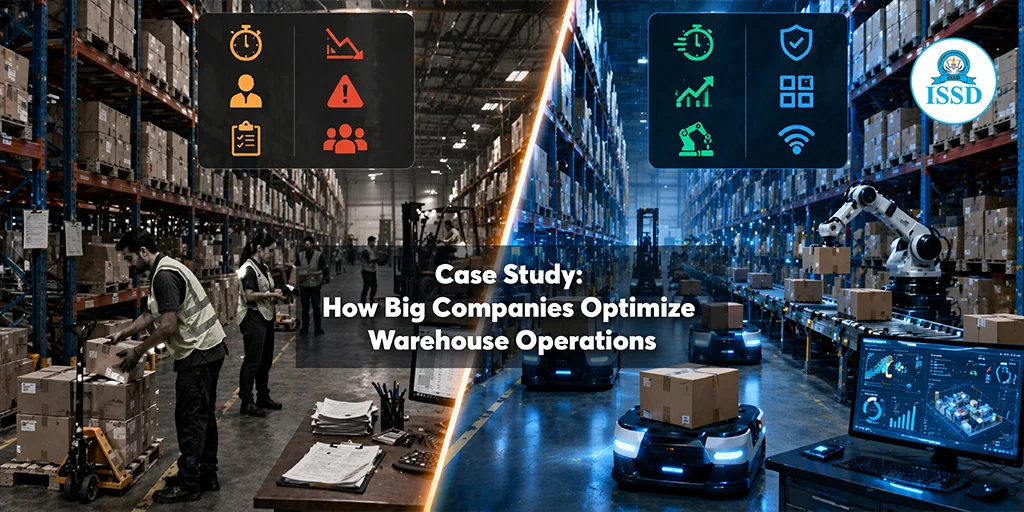
Case Study: How Big Companies Optimize Warehouse Operations
Enquire Here...
The success of large companies today depends heavily on how efficiently they manage their warehouses. In the world of logistics and warehouse management, even small improvements in operations can lead to massive cost savings, faster delivery, and better customer satisfaction.
This is why companies invest heavily in warehouse optimization strategies to streamline their operations.
In this blog, we will explore:
- Real-world case studies of big companies
- How they optimize warehouse operations
- Key strategies used in modern warehousing
- Lessons you can learn for your career
What is Warehouse Optimization?
Warehouse optimization refers to improving warehouse processes to:
- Increase efficiency
- Reduce operational costs
- Improve order accuracy
- Speed up delivery
In today’s warehouse management in India, optimization is not just an option — it is a necessity.
Why Big Companies Focus on Warehouse Optimization
Large companies handle:
- Thousands of orders daily
- Multiple warehouses
- Complex supply chains
Without proper optimization, they face:
- Delays
- Errors
- High costs
This is why optimization is a key part of supply chain management course concepts.
A Warehouse Management System (WMS) is a software that helps manage daily warehouse operations.
Case Study 1: Amazon – Advanced Automation & Smart Warehousing
Challenge:
Handling millions of orders daily across global warehouses.
Strategy Used:
- Robotics for picking and sorting
- AI-based inventory management
- Smart warehouse layout
Result:
- Faster order processing
- Reduced human errors
- Improved efficiency
Amazon uses advanced warehouse optimization strategies to maintain its global dominance.
Case Study 2: Flipkart – Efficient Inventory & Distribution Model
Challenge:
Managing large inventory during sale seasons.
Strategy Used:
- Real-time inventory tracking
- Regional warehouses
- Demand forecasting
Result:
- Faster deliveries
- Reduced stock shortages
- Better customer satisfaction
This approach is widely studied in warehouse management course modules.
Case Study 3: Walmart – Data-Driven Warehouse Management
Challenge:
Managing supply chains across thousands of stores.
Strategy Used:
- Data analytics for inventory planning
- Cross-docking techniques
- Automated systems
Result:
- Reduced storage time
- Faster product movement
- Lower operational costs
Walmart is a classic example of strong logistics and warehouse management practices.
Case Study 4: DHL – Technology-Driven Logistics Operations
Challenge:
Managing global logistics operations efficiently.
Strategy Used:
- Warehouse Management Systems (WMS)
- IoT-enabled tracking
- Robotics
Result:
- Improved tracking
- Faster delivery
- Increased accuracy
DHL shows how technology transforms warehouse management in India and globally.
Case Study 5: Reliance Retail – Expanding Warehouse Network
Challenge:
Supporting large-scale retail operations across India.
Strategy Used:
- Expanding warehouse infrastructure
- Integrating supply chain systems
- Efficient procurement planning
Result:
- Better stock availability
- Faster distribution
- Improved supply chain efficiency
This highlights the importance of procurement management course knowledge.
Case Study 6: BigBasket – Cold Chain Optimization
Challenge:
Managing perishable goods.
Strategy Used:
- Cold storage warehouses
- Temperature-controlled logistics
- Real-time monitoring
Result:
- Reduced wastage
- Improved product quality
- Better customer experience
From these case studies, we can identify common strategies.
1. Automation & Robotics
Used for:
- Picking
- Sorting
- Packing
Improves speed and accuracy.
2. Data-Driven Decision Making
Companies use:
- Analytics
- Forecasting tools
Helps in better planning.
3. Warehouse Layout Optimization
Efficient layout reduces:
- Travel time
- Handling time
4. Inventory Optimization
Techniques like:
- FIFO
- JIT
Improve stock management.
5. Technology Integration
Use of:
- WMS
- ERP
- SAP
Ensures smooth operations.
6. Strong Procurement Planning
Efficient procurement ensures:
- Continuous supply
- Cost control
If you want to build a career in this field, learn from these companies.
Key Takeaways:
- Technology is essential
- Efficiency is everything
- Data-driven decisions matter
- Inventory management is critical
These are core topics in any warehouse management course.
How These Strategies Are Applied in India
In warehouse management in India, companies are:
- Adopting automation
- Using digital tools
- Expanding warehouse networks
This creates huge demand for skilled professionals.
To work in such environments, you need:
- Inventory management skills
- Understanding of WMS & ERP
- Procurement knowledge
- Problem-solving skills
These skills are taught in a supply chain management course.
Career Opportunities in Optimized Warehouses
After learning these concepts, you can work as:
- Warehouse Executive
- Inventory Controller
- Procurement Assistant
- Logistics Coordinator
Why Learning These Concepts is Important
Understanding real-world case studies helps you:
- Think practically
- Improve problem-solving
- Perform better in interviews
This gives you a strong advantage.
If you want to build a career in warehouse and procurement, ISSD (International School of Skill Development) is one of the best options
What You Learn at ISSD
ISSD course includes:
- Warehouse management concepts
- Inventory management techniques
- Procurement processes
- Introduction to ERP & SAP basics
Learning Approach
ISSD provides:
- 100% live online classes
- Industry-oriented curriculum
- Job-focused learning
- Real-world case-based explanations
Key Advantages
✔️ TUV SUD certification
✔️ Strong placement support
✔️ 10,000+ placements achieved
✔️ Flexible learning
Course Fees (ISSD)
6 Months Diploma
- Installment: ₹65,000
- Lumpsum: ₹57,000
2 Months Crash Course
- Installment: ₹70,800
- Lumpsum: ₹62,760
1. What is warehouse optimization?
It is improving warehouse efficiency and operations.
2. Why do companies optimize warehouses?
To reduce cost, improve speed, and increase accuracy.
3. Which companies use advanced warehouse systems?
Amazon, Flipkart, Walmart, DHL, etc.
Warehouse optimization is the backbone of modern logistics.
Big companies achieve success by:
- Using technology
- Improving processes
- Managing inventory efficiently
These strategies are essential for anyone entering this field.
If you want to build a career, learning these concepts through an online warehouse management course is the best step.
And with:
- Industry-focused learning
- Case-based approach
- Strong placement support
ISSD helps you understand and apply these real-world strategies effectively.