
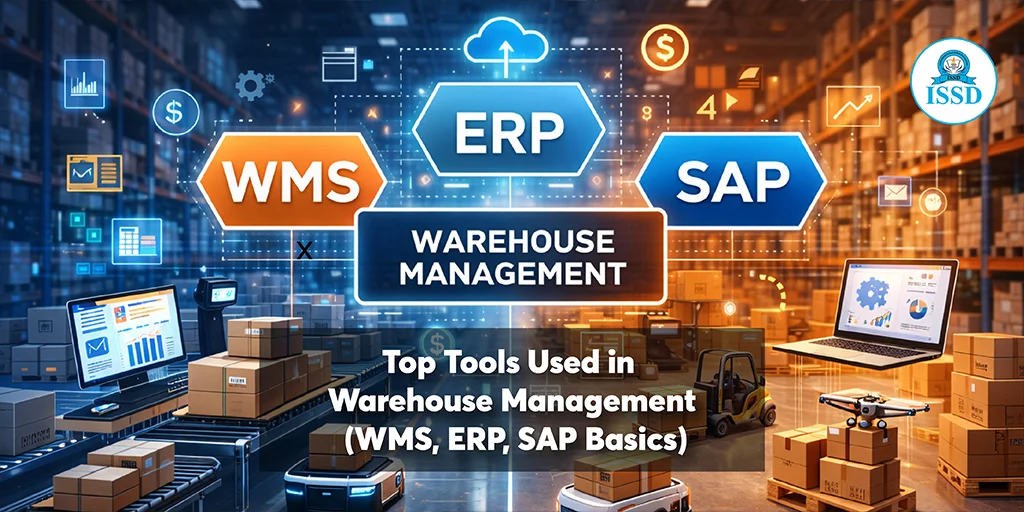
Top Tools Used in Warehouse Management (WMS, ERP, SAP Basics)
Enquire Here...
The modern logistics and supply chain industry is no longer driven by manual processes. Today, companies rely heavily on digital tools and software systems to manage warehouse operations, inventory, and procurement efficiently.
If you are planning a career in warehouse management and procurement management, understanding these tools is not optional — it’s essential.
In this complete guide, you will learn:
- What tools are used in warehouse management
- WMS, ERP, and SAP basics explained
- Why companies depend on these systems
- Skills you need to learn for jobs
- How learning these tools improves your career
Why Warehouse Management Tools Are Important
Earlier, warehouse operations were handled manually using:
- Paper records
- Basic spreadsheets
But today, companies deal with:
- High order volumes
- Fast delivery expectations
- Complex supply chains
This is why digital tools are used to:
- Improve accuracy
- Reduce errors
- Increase efficiency
- Track inventory in real time
A Warehouse Management System (WMS) is a software that helps manage daily warehouse operations.
Key Functions of WMS:
- Inventory tracking
- Order management
- Picking and packing
- Stock movement tracking
- Real-time updates
WMS ensures smooth warehouse operations from entry to dispatch.
Key Features of WMS
1. Real-Time Inventory Tracking
Tracks stock levels instantly
2. Order Management
Manages customer orders efficiently
3. Barcode Integration
Reduces manual errors
4. Warehouse Layout Optimization
Improves storage efficiency
Benefits of WMS
- Faster operations
- Reduced errors
- Better inventory control
- Improved customer satisfaction
ERP is a system that integrates different business functions into one platform.
Functions of ERP:
- Inventory management
- Procurement management
- Finance and accounting
- Sales and distribution
ERP connects warehouse operations with the entire business.
Key Features of ERP Systems
1. Centralized Data
All information in one system
2. Process Integration
Connects different departments
3. Reporting & Analytics
Helps in decision-making
Benefits of ERP
- Better coordination
- Improved efficiency
- Data-driven decisions
SAP is one of the most widely used ERP systems in the world.
It is used by large companies for managing operations.
SAP in Warehouse & Procurement:
- Inventory tracking
- Procurement planning
- Supply chain management
SAP Modules Relevant to Warehouse & Procurement
1. SAP MM (Material Management)
- Procurement processes
- Vendor management
2. SAP WM (Warehouse Management)
- Warehouse operations
- Inventory tracking
3. SAP EWM (Extended Warehouse Management)
- Advanced warehouse operations
To work with these tools, you need:
Technical Skills:
- Basic ERP knowledge
- WMS understanding
- SAP basics
Digital Skills:
- Data entry
- Report analysis
Soft Skills:
- Attention to detail
- Problem-solving
Why Learning These Tools is Important for Jobs
Companies prefer candidates who:
- Understand digital systems
- Can work with ERP and WMS
- Have basic SAP knowledge
This increases job chances significantly.
❌ Ignoring digital tools
❌ Learning only theory
❌ Not understanding real-world applications
These mistakes reduce employability.
How to Learn These Tools
To learn these tools effectively, you need:
- Industry-oriented training
- Real-world concepts
- Job-focused learnin
If you want to build a career in warehouse and procurement, ISSD (International School of Skill Development) is one of the best options
What You Learn at ISSD
ISSD course includes:
- Warehouse management concepts
- Inventory management techniques
- Procurement processes
- Introduction to ERP & SAP basics
Learning Approach
ISSD provides:
- 100% live online classes
- Industry-oriented curriculum
- Job-focused learning
- Real-world case-based explanations
Key Advantages
✔️ TUV SUD certification
✔️ Strong placement support
✔️ 10,000+ placements achieved
✔️ Flexible learning
After learning WMS, ERP, and SAP basics, you can work as:
- Warehouse Executive
- Inventory Controller
- Procurement Assistant
- Logistics Coordinator
Course Fees (ISSD)
6 Months Diploma
- Installment: ₹65,000
- Lumpsum: ₹57,000
2 Months Crash Course
- Installment: ₹70,800
- Lumpsum: ₹62,760
Salary Expectations
Freshers:
- ₹2.5 LPA – ₹4 LPA
Experienced:
- ₹5 LPA – ₹10 LPA+
Knowledge of tools increases salary potential.
1. What is WMS in warehouse management?
WMS is software used to manage warehouse operations and inventory.
2. Is SAP required for warehouse jobs?
Basic SAP knowledge is helpful and increases job opportunities.
3. What tools should beginners learn?
WMS, ERP basics, and inventory systems.
Warehouse management today is driven by technology.
To succeed in this field, you must understand:
- WMS
- ERP systems
- SAP basics
These tools are essential for modern logistics jobs.
If you want to learn them in a structured, job-focused way, ISSD is one of the best choices, offering online warehouse course:
- Industry-oriented online learning
- Strong placement support
- Proven 10,000+ placements